George Washington Carver: From Slave to Scientist (Heroes of History) by Janet Benge & Geoff Benge
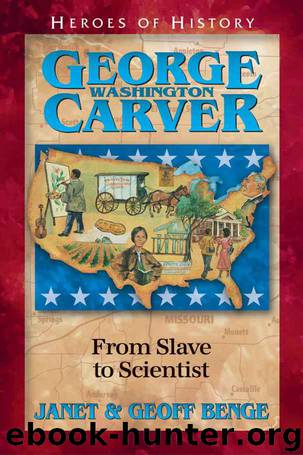
Author:Janet Benge & Geoff Benge [Benge, Janet]
Language: eng
Format: epub
Tags: scientists, heroes==, Christian biography, slavery, NAACP, peanuts, George Washington Carver
Publisher: Emerald Books
Published: 2011-08-15T23:00:00+00:00
Chapter 9
The Farmer’s Institute
George Washington Carver stood in front of his class, waiting for his students to find a seat. When they were all finally organized and a hush had settled over the room, he held up a clump of knotted, tangled string. “Do you see this?” he asked. “This is what ignorance is like.” Reaching into his pocket he pulled out a carefully wound ball of string. “And this,” he continued with a flourish, “is what intelligence is like.”
Several of the students nodded. They had been around George long enough to know what he meant. Everyone knows something. Most people know a lot of things. But it is the person who can organize what he or she knows who will get somewhere in life.
George also tried to demonstrate this important truth to his students in the way he taught them. For example, most other colleges taught botany by discussing different topics as if they had no relationship to each other. George, though, believed that everything in nature was interconnected in some way. When he taught botany, he tried to show these links between things. He didn’t just talk about potatoes, examining the flowers in one class and then discussing stalk diseases the next semester. If he was teaching about the potato, he taught everything he knew about potatoes right then and there. By the time class was over, students knew how to propagate the potato, when to plant, and how to decide what fertilizer to use. They would also understand what bugs and fungi to look for and know how to kill them. They would even know how to preserve potatoes and prepare some tasty potato dishes! George’s students learned far more than botany in his class; they learned all there was to know about one crop after another.
News soon got around about George Carver’s unusual teaching style. Local farmers began to realize he was a man they could learn from. George taught practical lessons that they could apply themselves. One or two at a time, farmers came to Tuskegee to ask George questions. They always left with not only the answer to their question but also a few other good ideas.
One day, after a poor farmer had dropped off a worm-ridden potato for analysis, George had an idea. Why not invite the local farmers to Tuskegee Institute once a month? With them gathered together this way, he could show them new farming practices, and they could learn from each other’s successes and failures. And so the Farmer’s Institute was born. On the third Tuesday of each month local farmers arrived at Tuskegee Institute for their meeting. They brought along their wives, since George had many practical tips for the women as well.
The Farmer’s Institute soon expanded into an all-day affair. Each month the farmers and their wives traipsed down to the experimental farm to see what George and his students were up to. At the farm, George would give a short demonstration on how to mound potatoes for greater crop yields or how to plant marigolds beside cantaloupes to help fend off pests.
Download
This site does not store any files on its server. We only index and link to content provided by other sites. Please contact the content providers to delete copyright contents if any and email us, we'll remove relevant links or contents immediately.
Fanny Burney by Claire Harman(26611)
Empire of the Sikhs by Patwant Singh(23092)
Out of India by Michael Foss(16862)
Leonardo da Vinci by Walter Isaacson(13347)
Small Great Things by Jodi Picoult(7161)
The Six Wives Of Henry VIII (WOMEN IN HISTORY) by Fraser Antonia(5522)
The Wind in My Hair by Masih Alinejad(5106)
A Higher Loyalty: Truth, Lies, and Leadership by James Comey(4971)
The Crown by Robert Lacey(4825)
The Lonely City by Olivia Laing(4811)
Millionaire: The Philanderer, Gambler, and Duelist Who Invented Modern Finance by Janet Gleeson(4486)
The Iron Duke by The Iron Duke(4370)
Papillon (English) by Henri Charrière(4281)
Sticky Fingers by Joe Hagan(4209)
Joan of Arc by Mary Gordon(4120)
Alive: The Story of the Andes Survivors by Piers Paul Read(4038)
Stalin by Stephen Kotkin(3974)
Aleister Crowley: The Biography by Tobias Churton(3648)
Ants Among Elephants by Sujatha Gidla(3474)
